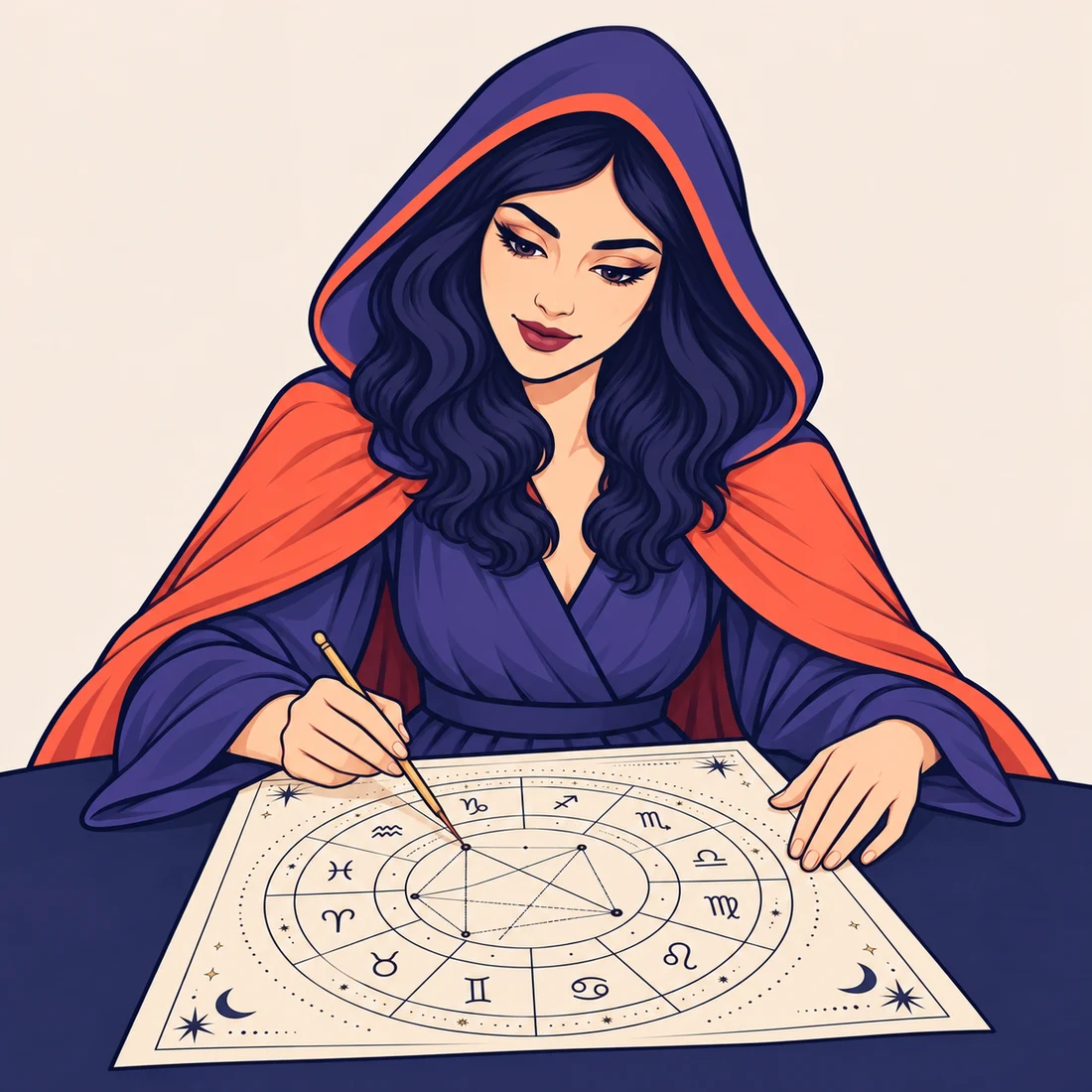
What is a birth chart?
A birth chart, or natal chart, maps the positions of celestial bodies for a particular time and place of birth. Astrology gives those positions symbolic meanings; calculating a position does not make its interpretation a scientifically established account of your personality.
Have your birth date, birth time and birthplace ready. The place means where you were born, not where you live now. If you already have a chart, keep its list of placements beside the wheel: it is often easier to read than the symbols alone.
Planets, signs, houses and aspects
Planets: what
The symbolic theme. For example, Mercury is associated with communication and Venus with values, pleasure and relationships. Astrology also calls the Sun and Moon “planets” in this interpretive shorthand.
Signs: how
The style attributed to that theme. A planet in a sign is a placement: for example, Mercury in Virgo. Do not confuse the sign with a house number.
Houses: where
Twelve areas of life, such as home, relationships or work. Their boundaries depend on birth time and the house system used. A house with no planet is not a missing part of your life.
Aspects: connections
Angles between planets. Conjunctions, oppositions, squares, trines and sextiles are common examples. They describe symbolic relationships, not guaranteed good or bad events.
A useful sentence is: planet = theme, sign = style, house = setting. Aspects connect the themes. Keep these layers separate until you are comfortable finding them.
Read your chart in six steps
- Check the birth details. A misplaced time or location can change the chart. Compare the input with your records before interpreting anything.
- Find your Sun. In astrology it is associated with identity and self-expression. Read its sign as one part of the picture, not a complete description of you.
- Find your Moon. It is associated with feelings, habits and comfort. Notice how its symbolism differs from the Sun rather than trying to make both say the same thing.
- Find the rising sign, or Ascendant. Often marked AC or ASC, this is the sign rising at the eastern horizon. It is linked with how you approach new situations; a reliable birth time matters.
- Add a house. Pick one placement and use its house to identify the area of life being discussed. Follow the house numbers on your chart rather than guessing from the wheel’s orientation.
- Look at one aspect. Use the chart’s aspect table or legend. Do not assume every coloured line has the same meaning across different tools.
Stop after a few placements. A short reading you understand is more useful than a long list of descriptions that seem to contradict each other.
A worked example: combining the layers
Mercury in Virgo in the third house
This is an invented teaching example, not your chart or an Oraclium result. Mercury supplies the communication theme; Virgo suggests an attention-to-detail style; the third house places the theme around everyday learning and communication.
A reflection might be: “When does careful wording help me, and when does checking every detail hold me back?” It does not prove someone is a gifted writer or predict their career.
If another placement suggests a different tendency, you do not need to choose a winner. Use the contrast as a question about situations and habits, rather than forcing yourself into a fixed label.
Explore your birth chart in Oraclium
Sign in, review the birth details in your profile, and open your birth chart. Check the displayed Green Emblem price before confirming a calculation. The app’s result determines which placements and interpretations are available; this guide explains general chart vocabulary, not a promise of every chart feature.
Open Birth ChartThis page is a guide, not a free chart calculator. Review our privacy policy before providing personal details.
Common birth chart questions
Is my birth chart the same as my horoscope?
A natal chart refers to your birth moment. A daily horoscope concerns a current period and is often written for a broad group sharing a zodiac sign.
Why do two chart tools show different houses?
They may use different house systems or settings. Check the birth time, location, time-zone handling, zodiac and house system before comparing interpretations.
Does an empty house mean nothing happens there?
No. “Empty” only means no plotted planet occupies that house in that chart; it does not erase that area of your life.
Do difficult aspects mean something bad will happen?
No aspect establishes a future event. Interpretations of tension are symbolic, not a reason to expect harm or make high-stakes decisions.